The Trial of Thelonius Pig * There Was a Bee in Terminal C * Feeling Sorry for my Cancer * To the Person Beside Me
The Trial of Thelonius Pig
by Clash Pierce
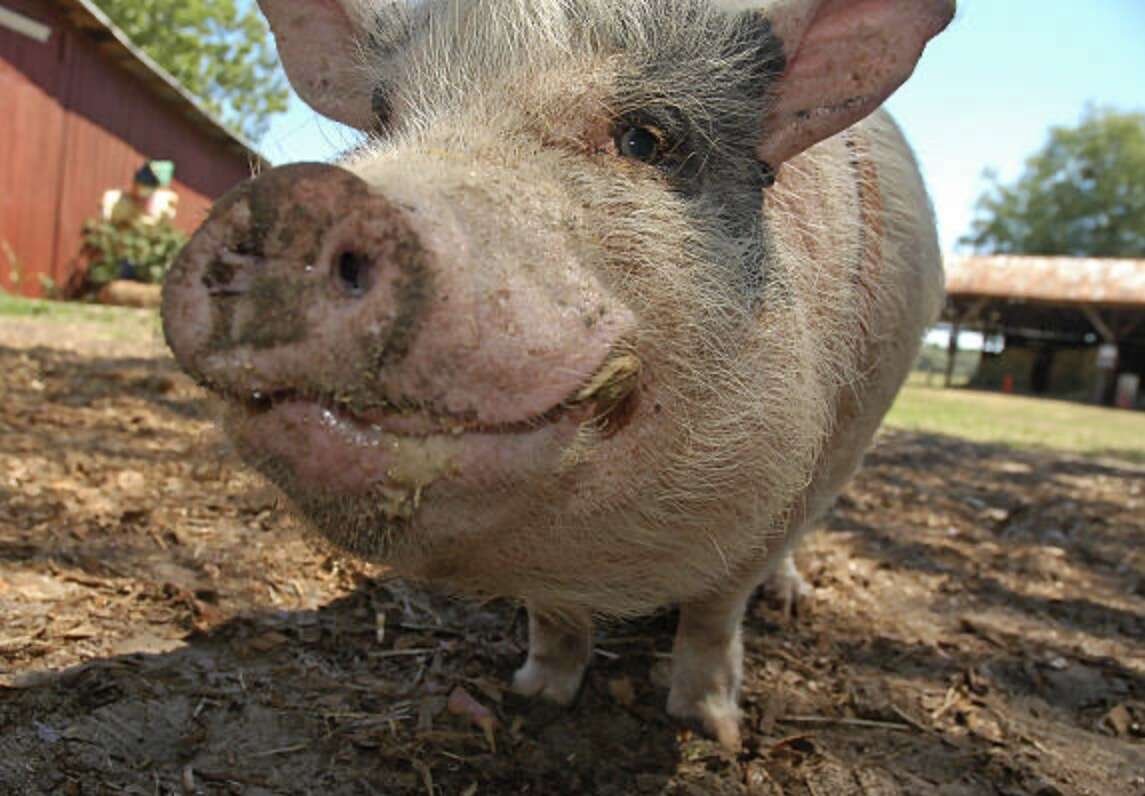
Everyone knew he was guilty. They saw it in the way he turned toward the camera, a Mona Lisa smile on his face like he knew something but wasn’t telling anyone. That video went viral, if 679 views is viral in a county with a population of 1,240. Of course that number was down by two, since Timmy Baines had bolted with $16,253 inherited from his grandpappy, who died two weeks before from ingesting a homemade toenail fungus remedy.
Sharp-eyed viewers of the video recognized it as an edited version of the one from seven years ago, when then-11-year-old Timmy was leading his prize pig into the Judge’s Barn at the Doughy County “Wine & Swine Pig-Out” Festival. The original video could still be found on the “Doing it Doughy Style” Facebook page. The caption read, “Little Timmy Baines Proudly Leads Thelonius Pig to his Final Judgment,” which a few folks today would tell you was a prescient turn of phrase.
The pig’s name was the result of a misunderstanding. When asked, Timmy had said, “I call him The Loneliest Pig,” which was because Timmy kept Thelonius separated from the other pigs so they could not eat the slop intended for Thelonius. But since little Timmy had a golf ball-sized wad of his grandpappy’s Beech Nut Chewing Tobacco in his cheek, The Loneliest came out Thelonius and that was that.
Until the day he died, Grandpappy (everybody called him Grandpappy) brought the slop. He had special dispensation from Hiram Bell, the Superintendent of Schools in Doughy County (though there was only one school) to collect it from behind Doughy Elementary. Each day a line of wheeled plastic garbage cans waited for him, five or six, seven if they had served cole slaw because the kids hated cole slaw. These were the garbage cans which, during lunch, hid beneath aluminum countertops with openings big enough for all the food the children couldn’t stomach, their soiled paper napkins, ketchup packets, and sporks, but small enough to prevent the plastic lunch trays from disappearing.
Every afternoon, Grandpappy parked his truck behind the cafeteria and dumped the garbage cans into the bed.
The slop truck was famous in Doughy County. A tangle of wires and a metal bracket was exposed where the instrument cluster used to be, because as luck would have it, Grandpappy arrived home from a Bud Light and pork rinds run when he noticed the odometer read 00666. The mileage had rolled over 100,000 a few months before, and Grandpappy could not have planned it better. He was three beers and half a bag of pork rinds into the afternoon when he decided to disconnect the odometer cable, and halfway through his 12-pack when he decided to remove the instrument cluster altogether and mount it over his collection of snapback hats and beaver bobbleheads from Buc-ee’s.
But the truck’s fame arose from a State Police traffic stop in front of the Piggly-Wiggly. The encounter was witnessed by the cashier and two customers who fogged the store’s windows, as well as Mrs. Ralph Tinkle, who insisted on being addressed as Mrs. Tinkle, and not Vernice, years after her husband had gone to be with Jesus by shooting at ten pounds of Tannerite to find out whether his lever-action Winchester would cause it to explode.
Mrs. Tinkle was in front of the grocery store, walking her brown and white Yorkipoo, Shit Stains. When the State Police car eased up behind the slop truck and blue-lighted Grandpappy, all eyes were watching to see the old man get a ticket.
The trooper chatted with Grandpappy at his driver’s window. Then she returned to her car, the blue lights stopped flashing, and she drove away. No ticket.
Grandpappy rooster-strutted into the Piggly Wiggly, chest puffed out, triumphant. Mrs. Tinkle followed with Shit Stains in her buggy. She and the other witnesses approached. The cashier spoke first.
“You gonna tell us what happened or you gonna stand there grinnin’ like a hoss chewin’ briars?”
“She asked me,” said Grandpappy, “Sir, do you have any idea how fast you were going?”
“I says no ma’am, and as a matter of fact I don’t know what my oil pressure is, whether my engine is overheating, how my charging system is working, or whether I’m about to run out of gas.”
That is why, after mounting the instrument cluster high on a wall in his trailer, people from all over Doughy County came to look at it as one might gaze upon an image of Christ on the cross.
But Grandpappy’s old truck was perfect for one thing: hauling pig slop.
Each garbage can spilled into the truck increased pressure on the steaming mass below and caused a fresh squeeze of rancid garbage juice to squirt from beneath. Milky fluid oozed from the tailgate and dripped from the bumper. Grandpappy thumped the bottom of the plastic containers with a closed fist, releasing the last clumps of compost, alive with insect larvae and unseen pathogens.
A sixth-grader leaving school rounded the corner, vomited, and backed away. Above, buzzards circled.
Thelonius Pig’s slop was like catnip to a kitten. He rooted through it, buried his face in it, and delighted in it so much that people would gather upwind and watch Grandpappy pull on his rubber waders to pitchfork the rotting stuff to the pig. And the pig grew, so much so that Timmy’s blue ribbon was never in doubt.
Even those who recognized the edited festival video dared not speak up, because the case was all the talk among people in line for lottery tickets at the Dollar General, in the fetid and rackety teacher’s lounge at Doughy Elementary, and even at the Wednesday Night Bible Study Fellowship and Covered Dish at Doughy United Free Will Church of the Almighty and Righteous God—all the places where community opinions became Truth.
Little Timmy was the only one with credibility to challenge the accepted Truth about the viral video—now known as the Perp Walk—by comparing it to the festival reel. But Timmy had escaped Doughy County for a new life in an Alabama doublewide three hours away. Opinion was mixed whether Timmy was the smartest Baines in the family or was running from something. If not the smartest Baines, he was certainly the best educated, having attended 8th grade three times before aging out of the system.
Timmy had left his Dodge pickup behind. This gave rise to the “running from something” theory, because he was known to love that truck. He had installed wheel spacers so the tires spun pinwheels of oily runoff onto windshields after a rain, and jacked it up and wired lights in the wheel wells so you could see he had spent all afternoon with a pressure washer to get the truck’s underside to shine—all so girls would swoon and he could park at the Doughy Drive-In on Adult Features Night and you would have no way of knowing there was no one in the truck with him.
But he had, in fact, left the truck in the crabgrass and dandelions where his dead grandpappy’s orange-striped Lux DeLite camper trailer was axle-deep in the earth. Some were convinced that Timmy was filled with ennui, tired of whispers about the truck compensating for the lack of length and girth of his personal plumbing. It did not help that Timmy’s first cousin, Vidalia, the only one who would know for sure, laughed and nodded when the topic came up.
Timmy had said goodbye to no one, not even Vidalia, and Thelonius Pig had lost his only friend.
Timmy was believed to be living high on the hog in Alabama now, a phrase thought by some to be insensitive to the poor pig’s feelings because it was assumed Thelonius understood English even if he didn’t grasp idioms. It wasn’t just the doublewide: Timmy was said to be driving a lowered and stanced Honda Civic now, white with a gray carbon-fiber hood, coffee can mufflers, and a rear wing spoiler taller than the hood of his old truck, causing the rumors about Timmy’s manhood to persist.
The County’s only lawyer was Glen T. Moore. He had a billboard on the dual, as locals called it, the highway that bypassed Doughy County forty years ago and condemned it to decline. The billboard had him leaning toward the camera from the seat of a gold golf cart, his gold tooth gleaming, hand up to his ear in the “call me” gesture.
Moore was after big truck liability cases, the more gruesome his client’s injuries, the better. His ideal client was Anson “Big Paul” Doughy, the last living descendant of the original Doughys to settle the county. Living, but only by grace of the Almighty and Righteous God after a tractor trailer full of dildoes and toaster ovens headed for an Amazon distribution center crossed the center line and bounced Big Paul’s Smart Car back in the direction from which it had come, like a dodgeball pounded off a third grader’s head in PE.
The extraction took a day and a half because the Doughy Volunteer Fire Department had trouble finding their Jaws of Life, having left it one county over at Tri-County Consolidated High School after a demonstration hosted by the Glee Club the week before Prom, highlighting the dangers of buzzed driving. The device was found under a piano bench, propping one corner where a wooden leg should have been. Complicating the rescue was the fact that Big Paul didn’t sit inside his Smart Car as much as he put it on, like a chubby two-year-old in last year’s onesie.
Word traveled fast while the Fire Department struggled with Big Paul. Soon low-cost, stolen toaster ovens appeared on eBay and Facebook Marketplace. No one discussed the final destination of the dildoes.
Attorney Moore decided to accept the Thelonius Pig case. He said he’d handle it pro bono, but he was sure, after everything was said and done, he could convince the judge to award him guardianship of Thelonius no matter the outcome of the case. He figured there was an advertising angle in being the man who would represent a pig and imagined Thelonius in the golf cart beside him. “Have your PIG DAY in court.” “The Piggest Payouts!” “You deserve PIG MONEY!”
There was some debate whether a pig was entitled to a legal defense at all. In Thelonius Pig’s case, the prevailing thought was that while most pigs might deserve legal representation, this pig certainly did not, because look at him—he’s guilty.
The first potential juror was Cletus Filcher, a farmer who made a living getting paid by the state for not growing tobacco.
Mr. Moore introduced himself to Clete, though everybody knew everyone else—it was how things were done during voir dire. These formalities were especially important when the defendant was a pig and the people of Doughy County had worried about ridicule ever since a reporter from the Tri-County Herald showed up.
Moore asked Clete Filcher, “Sir, have you formed an opinion about the innocence or guilt of my client?”
Mr. Filcher, wearing a white dress shirt that still had the creases where he had pulled away six straight pins and removed it from its cardboard stiffener, stared at attorney Moore. The lawyer was about to restate the question using simpler words, when Clete nodded.
“Yessir,” he said. “Sheriff wouldn’t have arrested him if he wasn’t guilty.” Mrs. Tinkle whispered “Amen, brother Clete” while the courtroom murmured “mm-hmm” and “that’s right” and more than one voice said, “Look at him!”
Mrs. Tinkle was there with Shit Stains. She had told a deputy that the animal was an emotional support dog, and when the deputy appeared unconvinced, she had said “And he can smell explosives.”
Defense counsel motioned for relocation of the trial, arguing that Thelonius Pig could not expect an impartial jury since everyone agreed the pig was not only culpable but showed no sign of remorse.
Judge Lee Davis Roberts turned to the jury. “Can y’all forget what you think you know and make a decision based on the evidence presented in this trial?” The twelve nodded. “Ah-ite then, denied.” He looked at the prosecutor, DA Carol Henson. Henson stood ready to proceed, wearing a gray pantsuit and sensible heels. She had not been thrilled to receive this case but was determined to handle it properly.
Judge Roberts wasn’t about to give away jurisdiction of the case anyway. Sending the trial out of Doughy County would mean that Drew Dowdy’s Hot Dogs and Gene’s Gas and Service and even the Piggly Wiggly would lose customers. The event was bringing people from as far away as Tawny Rae’s Trailer Court and Campground, and the Herald article would have readers across the whole tri-county area. All that meant that moving the trial would sink the judge’s chances in the next election.
Thelonius Pig sat in a crate beside the defense table. He had been off his usual feed and was generating moist, paint-peeling flatulence. Court Reporter Corrine Allwright was reminded of her five-year-old son, Willy, repeatedly crushing a whoopie cushion in his bathwater and laughing so hard he peed. Attorney Moore pretended there was no revolting odor but nudged the crate with his foot as far as he possibly could. The bailiff retrieved a can of air freshener from the judge’s private restroom, so the area surrounding the pig smelled like Jasmine & Honeysuckle Febreze-scented sewage.
“Call your first witness, Ms. Henson,” the judge said, and she asked Mr. James Frazier to come forward. Mr. Frazier had been sitting on his porch when he saw, or claimed to have seen, Thelonius Pig across the street and several houses down, making him the only pig within half a mile of the crime scene.
Ms. Henson said, “Mr. Frazier, is the pig you saw that night in the courtroom today?”
“Yes ma’am he is.”
“Can you point to him?”
Mr. Frazier pointed to Thelonius Pig, whose backside was aimed toward the witness stand.
“Your witness,” said Carol Henson, and Mr. Moore approached.
“Mr. Frazier, what were you doing on your porch that evening?”
Moore was following the old lawyer’s adage about asking a question only when he knew the answer. Everyone knew what Mr. Frazier did on his front porch each evening.
“Drankin.”
“What were you drinking, Mr. Frazier?”
“Brown liquor and Mountain Dew.”
“How many?”
“However many will fit in a half gallon milk carton.”
Mr. Moore paused to let the jury digest the idea that the witness was probably drunk during the night in question, since he couldn’t come right out and say it himself, but the jury was ready to move on. Mr. Frazier on his front porch and sober would have been absurd.
Mr. Moore leaned against the railing in front of the witness stand. “Mr. Frazier, you said you saw my client that night, am I right?”
“Yessir, I did.”
“And he was a half mile away?”
“Four houses down.”
“Was it dark, Mr. Frazier?”
“Yessir it was. But they’s porchlights.”
“Porchlights.” Mr. Moore looked at the jury. “Mr. Frazier, do you wear glasses?”
“Yessir, I wears ‘em for reading and watching the TV.”
And here is where Mr. Moore forgot the lawyer’s wisdom about asking questions when you don’t know the answer.
“Mr. Frazier, just how well can you see in the dark?”
James Frazier wrinkled his eyebrows. He squinted up at the courtroom ceiling, then down at Mr. Moore.
“Sir, on a clear night, I can see all the way to the moon.”
Laughter filled the courtroom. Jurors covered their mouths, bit their lips, or turned away. At the prosecutor’s table, Carol Henson knew that her case could not possibly become stronger than at this moment. She would call no more witnesses—and at this moment, defense counsel knew his case was lost. His only hope, Thelonius Pig’s only hope, was that he could craft a closing argument that might appeal to the humanity of at least one juror, one compassionate person among twelve whose heart could be reached but whose mind would not be changed Twelve Angry Men-style by the other eleven.
So Attorney Moore called no witnesses, Judge Roberts sent the jury to deliberate, and the wait began. The deputy on duty at the metal detector had it five to one for conviction and the Herald reporter, who had once sent ten dollars to People for the Ethical Treatment of Animals and hoped that one of the jurors had sent them some money, too, took the bet.
The bailiff approached the bench with a slip of paper. The jury had presented a question: “If the pig is convicted, will he fry?”
Judge Roberts wrote, “Capital punishment is not an option in this case” and the bailiff returned to the jury room.
A moment later, there was a second question: “If convicted, does Mr. Pig get conjugal visits?”
The judge wrote, “Y’all need to take your job seriously or I won’t send in your sandwiches.”
The jury returned after deliberating half an hour. They had spent no more time discussing the evidence than crafting messages about the pig frying or having opportunities for intimacy. The metal detector deputy rushed back to the courthouse from Piggly Wiggly, where he had been sent for something stronger than Febreze.
“Have you reached a verdict?” the judge asked.
The courtroom’s white-noise murmur fell silent. Not a soul breathed; all eyes were on the foreman.
“Yessir, we done found the defendant, Thelonius Pig…”
Bang! Timmy Baines burst through the courtroom door. Heads turned. Shit Stains barked and Mrs. Tinkle nearly soiled herself. Afternoon sunlight cast Timmy in silhouette. He stood, feet shoulder-width apart, a Buc-ees beaver bobblehead in one hand and the slop truck’s instrument panel in the other, held high, asserting the authority of the slop truck, Grandpappy, and everything that was Right and Holy and Truth in Doughy County. Vidalia blushed and shifted, making space for Timmy.
Attorney Moore saw opportunity. “I call Timmy Baines!”
“Objection!” said Ms. Henson.
“Let him speak!” Someone cried. “Let him speak, let him speak,” the crowd chanted.
The judge called, “Silence!” and the bailiff rested his hand on the grip of his holstered pistol.
Moore and Henson approached the bench. Mr. Moore extended an arm toward Timmy, who now stood midway the aisle. The lawyers spoke and Judge Roberts decided.
Timmy took the stand.
Attorney Moore approached. Thelonius Pig faced the witness stand, whack-whack-whacking his little pink tail against his crate, grunting softly.
Moore asked Timmy where he had been on the night in question.
“I was at the Doughy Drive-In. It was Adult Features Night.” Timmy figured it was best to get that detail out sooner than later. “And Thelonius Pig was with me.”
The crowded courtroom gasped as one. Carol Henson put her pen down and leaned back. The judge turned toward Timmy and said, “Mr. Baines, can any person corroborate your statement?”
Timmy looked at Mr. Moore.
“Did anybody see you there with Mr. Pig?” Moore said.
“Nawsir, he was sitting in my truck. But Mr. Drew Dowdy was running the hot dog stand, and I bought two funnel cakes. He asked me, ‘Got a girl in there with ya do ya?’ and I said, “Naw, just my pig.”
The judge looked over the crowd. “Is Mr. Drew Dowdy in the courtroom?”
Mr. Dowdy approached. Carol Henson considered an objection—this was entirely out of order—but she read the jury’s faces and Judge Roberts had already turned the courtroom into a circus.
“Mr. Dowdy,” Attorney Moore asked, “Do you remember the conversation with Mr. Baines?”
“Yessir I do. He said he really wanted a hot dog but he didn’t want to offend his pig. I told him he could eat it right here but he said the pig would smell it on him.”
Mr. Moore spun toward the courtroom. “The defense rests!”
The crowd applauded. Ms. Henson smiled and gave her opponent a nod. Mrs. Tinkle’s Yorkipoo broke free and Shit Stains appeared all over the courtroom.
Judge Roberts rapped his gavel—bam! “This pig is innocent!” Timmy rushed down the aisle with Thelonius Pig, and Vidalia ran after him.
The crowd rose, cheering. The jury applauded, and Carol Henson shook Mr. Moore’s hand. “Well done, Glen,” she said. “This was your day.”
Epilog: One Year Later
Timmy’s new company, Grandpappy’s Slop Bucket, served all of northeast Alabama. He and Vidalia ran it with two vehicles after retrieving Timmy’s old Dodge and Grandpappy’s famous truck from home. Mrs. Tinkle, having become Vernice and run off with the funeral home director who had done such a fine job sewing Mr. Tinkle back together, had entrusted her beloved Shit Stains to Vidalia. Timmy and Vidalia renamed the dog Cole Slaw. Thelonius Pig and Cole Slaw became best friends, and the four of them—soon to be five—lived happily ever after.
The End
There Was a Bee in Terminal C
by Clash Pierce
There was a bee in Terminal C.
She flew through the jet bridge at Gate 23.
The bee had departed from Terminal C.
The bee flew aboard Flight 703,
the next plane departing from Gate 23.
The bee sat atop Row 5, Seat D.
Flight 703 left runway 10-C.
The plane was flying, but not the bee.
She looked around from Seat 5D.
The bee noticed me in seat 7C.
She flew across the aisle to say hi to me.
The plane was flying and also the bee.
The bee and I in seat 7C
looked out the window and sipped lemon tea.
The plane was flying, not me or the bee.
Our flight landed at a quarter to three
and taxied to a gate at Terminal D.
With the airplane parked I said bye to the bee.
___________________________________________________________________________________________
Feeling Sorry for my Cancer
by Phil Scearce
You can buy Fuck Cancer shirts, hoodies, shoelaces, dog collars, or a coffee mug with not one, but four one-finger salutes to cancer. Sorry, but the “Fuck Cancer” necklaces are sold out. Not to worry—celebrate Christmas with a Fuck Cancer tree ornament. Festive!
The fine people at letsfcancer selling these items have their hearts in the right places. Same with fuckcancer.org and any number of creative folks on Etsy (a popular choice: the Cancer is a Hoe” t-shirt).
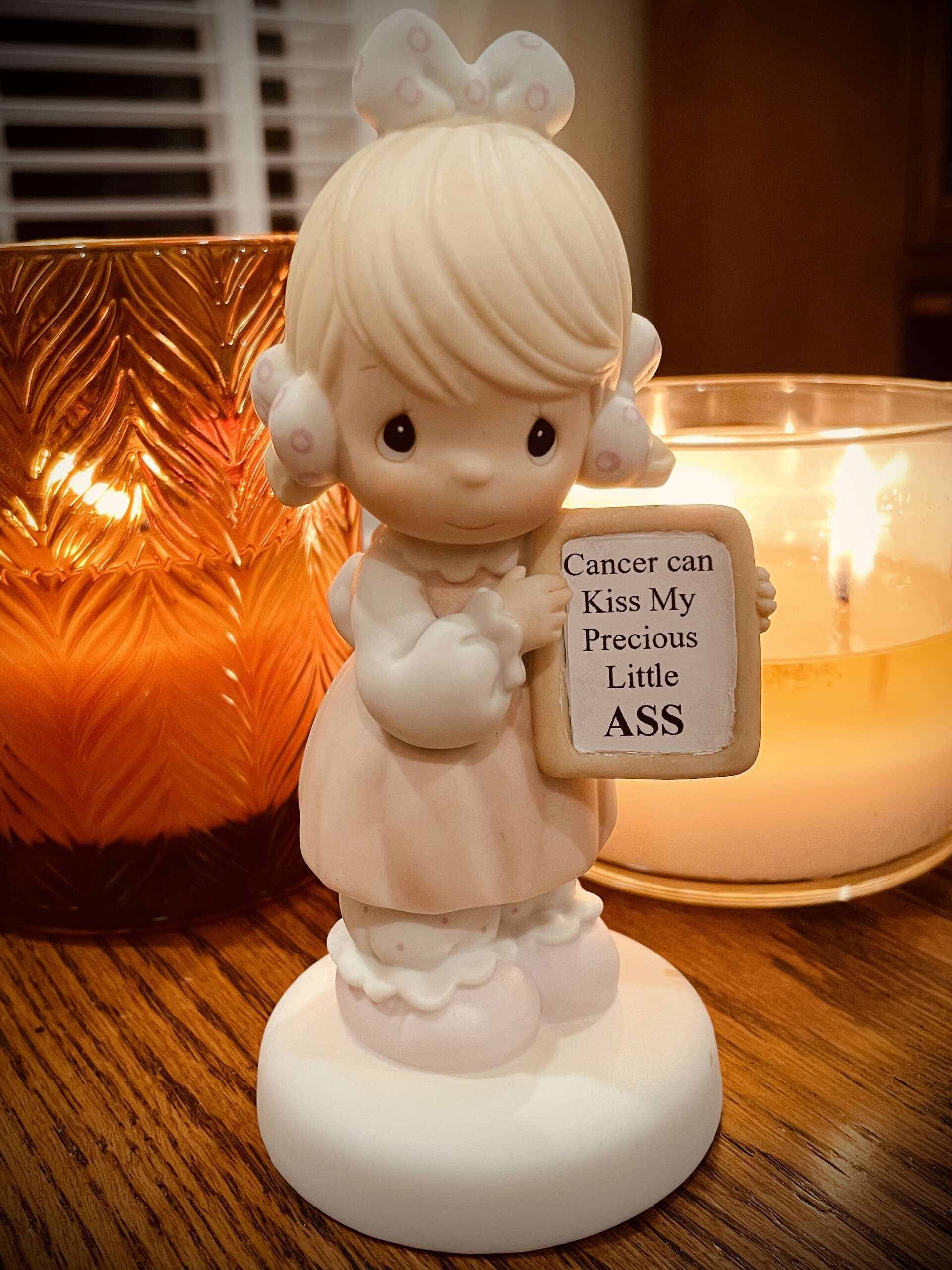
But you won’t see me wearing a Fuck Cancer morse code bracelet, shopping with a Fuck Cancer tote, or burning a Smells Like Phil’s Kicking Cancer’s Ass soy wax candle.
Why?
I kinda feel sorry for my cancer.
I didn’t get here without first having all the feels. When a Physician’s Assistant entered my beige, airless examination room back in 2019 and said, “You’ve got cancer,” I was in shock.
Shock gave way to feeling sorry for myself.
“Why me” is a dark whirlpool, though. It pulls inexorably down to depression—which I also experienced. Its equally unanswerable-question cousin is “How did this happen?”
I thought about the years in high school and college working part time at Rice’s Gulf, where the 94-octane No-Nox smelled so good. Or when I was ten, riding bikes with my friend Walt on Charles Street, weaving in and out of DDT clouds pumped from the city’s mosquito fog trucks. Maybe it was later, an adult frequently bingeing on beer, or the summer I started smoking Kool Menthols before I realized I was hooked and gave them up cold turkey, or years of processed food, or…
Searching for answers to these impossible questions is a maze with no way out. Staying in it starves the soul.
I have a loving support system with my life partner, a caring family, and friends who mean it when they ask how I’m doing. I’m fortunate to have these people in my life. They sustained me until the question instead became, “What’s next?”
Surgery to remove a kidney and the cantaloupe-sized tumor growing around it. Scans. Optimism. A return to normalcy, but with a foot-long scar on my belly reminding me that whatever caused this cancer was floating around inside me still.
Then disappointment. Five years on, the surgeon’s confident “We got it all” proved wrong. The cancer has metastasized—oddly enough, I have kidney cancer in a lung. “What’s next” became medicine that makes me tired, weak, unable to do many of the things I love, testing me—but also hope, because I am getting better.
*******
I’ve had lots of time to reflect. I’ve come as close to answering what caused it as I will get, and it is this: a cell inside of me got confused. Turned around. Made a mistake.
It was trying to do its job.
It didn’t want to hurt me.
Imagine for a moment that cancer is self-aware. Self-aware, it knows it will be cut away, irradiated, controlled or overpowered by toxic medicine. Or it will finally kill its host—and itself.
Self-aware, cancer knows it’s hated. Feared. It knows that vast sums are invested in finding ways to prevent it, conquer it, end it.
Absurd? No more than the sentiment expressed by a t-shirt that says, “Dear Cancer, You Fucked with the Wrong Bitch.”
So I am not the first to think of cancer as a thinking thing. It is a monster inside me, and I want it gone.
*******
Poor little misguided cell.
It started as part of my body and somehow lost its way.
_________________________________________________________________________________________________
To the Person Beside Me
by Phil Scearce
Skin deep, beauty has no heart. Beauty is shallow. It shoulders no burden; it doesn’t care.
But only to those who have not yet learned
how beauty reveals itself.
I know beauty.
Beauty isn’t in a mirror, within a frame, or on the page.
Beauty is in motion. It’s in action. It’s in commitment when commitment is tested and
no failing found.
Beauty meets fear with hope, anxiety with calm, and thoughts of surrender with determination to fight
and overcome.
Beauty is in shouldering a burden, a greater share
and a greater share again.
Beauty is constant. Here tomorrow, whatever it brings, and every tomorrow after.